Motion sensor lights are a simple way to add automatic lighting around a home. They can illuminate a dark walkway, driveway, porch, garage or backyard when movement is detected without requiring the light to stay on all night.
But if you are considering motion-activated lighting for security, there is another question worth asking: do you only need a light, or would a light bulb camera be more useful?
A motion sensor light can illuminate an area. A light bulb security camera can add video, motion alerts, two-way audio and recording while using an existing light socket. Some current bulb cameras can also turn their integrated light on when motion is detected.
This guide explains the differences, what to look for in a motion sensor light, and when a motion light, light bulb camera or dedicated floodlight camera makes the most sense.
Jump to:
- Quick Answer
- What Are Motion Sensor Lights?
- Motion Light vs Light Bulb Camera
- Benefits of Motion Sensor Lights
- Features to Look For
- Best Places to Use Them
- When a Light Bulb Camera Is Better
- When a Floodlight Camera Is Better
- Installation Tips
- Reducing False Triggers
- Frequently Asked Questions
- Final Thoughts
Quick Answer: Motion Sensor Light or Security Camera?
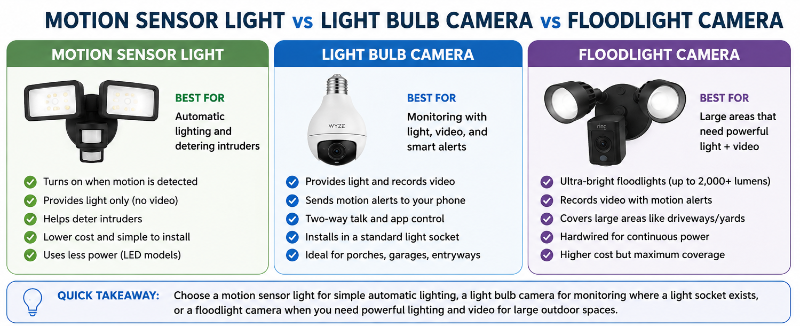
Choose a motion sensor light if your main goal is automatic illumination. It is usually the simplest option for pathways, stairs, entrances and other areas where you mainly want light when someone approaches.
Choose a light bulb camera if you also want to see what caused the motion, receive camera alerts, record video or communicate through the device.
Choose a dedicated floodlight camera if you want a more permanent outdoor security installation with substantially stronger lighting and camera features.
| Feature | Motion Sensor Light | Light Bulb Camera | Floodlight Camera |
|---|---|---|---|
| Automatic lighting | Yes | Often | Yes |
| Video recording | No | Yes | Yes |
| Phone alerts | Usually no | Usually yes | Usually yes |
| Two-way audio | No | Often | Often |
| Simple bulb-socket installation | Some models | Yes, for screw-in models | No |
| Strong area lighting | Varies | Usually moderate | Usually strongest |
What Are Motion Sensor Lights?
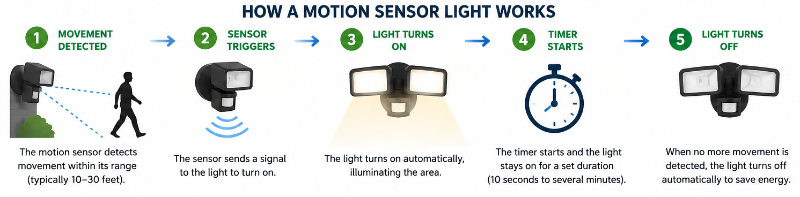
A motion sensor light combines a light with a sensor that detects activity in its monitored area. When the sensor is triggered, the light switches on automatically and normally stays illuminated for a selected period.
Many common motion lights use passive infrared, or PIR, sensing. Rather than literally seeing a person, a PIR sensor responds to changes in infrared energy moving across its detection area.
Other products may use microwave, radar or combined sensing technologies. The exact technology matters less to most homeowners than whether the light reliably detects movement in the area they actually want to cover.
Motion Sensor Light vs Light Bulb Camera
The two products can look similar from a security perspective because both may react when someone approaches your property. What happens after that detection is very different.
A traditional motion sensor light mainly answers one need:
“Turn on the light when something moves.”
A light bulb camera can potentially answer several:
- What caused the motion?
- Can I see the area live from my phone?
- Was video recorded?
- Can I receive an alert?
- Can I speak to someone through the camera?
- Can the light itself react to motion?
For example, the current Wyze Bulb Cam combines a 2K security camera with an integrated light of up to 800 lumens. Wyze lists manual, ambient-light, scheduled and motion-activated lighting controls. It also supports local microSD recording and motion alerts.
That makes a modern bulb camera a potential replacement for a basic motion light in some locations, but not every location needs a camera.
Learn more: What Is a Light Bulb Camera?
Benefits of Motion Sensor Lights
Automatic Lighting
The biggest advantage is convenience. The light comes on when someone approaches without requiring them to find a switch.
This can be useful when carrying groceries, taking out garbage, walking to a vehicle or entering a dark garage.
Improved Visibility
Motion lighting can make steps, pathways, driveways and entrances easier to see at night.
For many homes, this practical safety benefit is more important than using the light specifically as a security device.
Less Unnecessary Lighting
A motion-activated light does not need to remain at full brightness all night. Depending on the product, you may be able to choose how long it stays illuminated after motion stops.
No Camera or Recording
This can actually be an advantage.
If all you want is automatic lighting, a motion sensor light avoids the Wi-Fi connection, app, video storage, account security and privacy considerations that come with a connected security camera.
What to Look for in a Motion Sensor Light
1. Detection Area
Do not choose a light based on the longest advertised detection distance alone.
Think about where movement will actually occur. A front walkway may need a relatively focused detection zone, while a driveway or backyard may need broader coverage.
Sensor positioning also matters. Motion moving across a sensor’s detection area may be detected differently from movement directly toward it.
2. Adjustable Sensitivity
Adjustable sensitivity can help when a light is being triggered too easily.
Trees, animals, traffic, people on a nearby sidewalk and other activity can all affect how useful a particular sensor position is.
3. Brightness
Choose brightness for the job rather than automatically buying the highest lumen number.
A small entrance or staircase may need much less light than a driveway or backyard.
Also consider whether excessive brightness could shine into neighbouring properties or windows.
4. Detection Zones and Sensor Direction
A sensor that can be aimed or configured for the area you care about is often more useful than one with an enormous detection range.
The goal is to detect useful activity while reducing unnecessary triggers.
5. Adjustable Light Duration
Look for a timer or duration control if you want to determine how long the light stays on after motion is detected.
A short duration may work for a walkway. An entrance, driveway or work area may benefit from a longer period.
6. Dusk-to-Dawn Control
Many outdoor motion lights include a photocell or ambient-light sensor so motion activation only occurs when it is dark enough to need illumination.
This prevents the light from unnecessarily switching on during daylight.
7. Outdoor Rating
If the light will be outdoors, check the manufacturer’s actual weather rating and installation instructions.
Do not assume that every outdoor light can be installed in every exposed location. A product suitable under a covered porch may have different requirements from one designed for direct exposure to rain and snow.
8. Power Source
Common options include:
- Hardwired: Useful for permanent installations with existing electrical wiring.
- Solar: Useful where wiring is unavailable, provided the solar panel receives enough sunlight.
- Battery: Flexible placement but requires battery maintenance or charging.
- Screw-in socket: Convenient where a suitable powered light socket already exists.
Best Places to Use Motion Sensor Lights
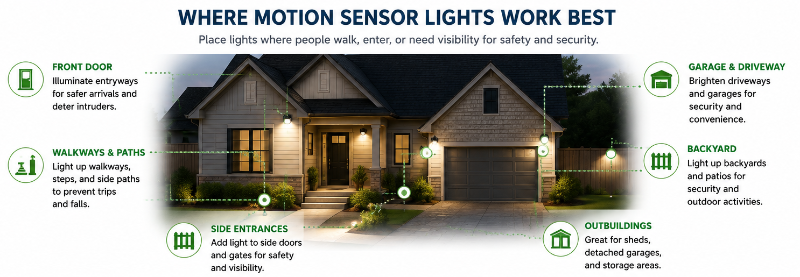
Front Entrances
Automatic lighting can illuminate the door, lock, steps and approaching visitors.
Driveways
A properly positioned light can illuminate vehicles and people entering the driveway without keeping the area brightly lit all night.
Garages
Motion lighting can be useful both outside a garage and inside areas where the main light switch is inconvenient.
Walkways and Steps
These are excellent locations when the primary goal is nighttime visibility rather than surveillance.
Backyards and Side Entrances
Motion lighting can provide illumination in parts of the property that are otherwise dark and infrequently used.
Closets, Basements and Utility Areas
Small battery-powered or plug-in motion lights can provide hands-free indoor lighting without requiring a security camera.
When Is a Light Bulb Camera Better?
A motion sensor light tells you that motion occurred by turning on a light. It does not tell you what happened after you went to bed or while you were away.
A light bulb camera makes more sense when you want:
- Live video from your phone
- Motion notifications
- Recorded video
- Two-way audio
- Night vision
- A camera without installing a separate wired mount
If you already have a suitable powered light socket overlooking a front entrance, porch, garage or driveway, a screw-in camera can be a convenient option.
Placement still matters. The socket needs continuous power, adequate Wi-Fi, enough fixture clearance and a useful camera angle.
Use our Light Bulb Camera Buyer Checklist before choosing one.
See our Best Light Bulb Cameras for Outdoor Use.
Can a Light Bulb Camera Replace a Motion Sensor Light?
Sometimes.
If the bulb camera includes motion-activated lighting and provides enough brightness for the area, one device may perform both jobs.
The current Wyze Bulb Cam is a good example. Its integrated light produces up to 800 lumens and can be configured for motion-activated lighting. Wyze also allows compatible Accessory Bulbs to synchronize with the Bulb Cam, with up to five accessory bulbs linked to one camera.
However, an 800-lumen bulb is not the same thing as a pair of high-output outdoor floodlights.
If you need to illuminate a large driveway or backyard, a dedicated motion floodlight or floodlight camera may be a better solution.
When Is a Floodlight Camera Better?
A floodlight camera combines stronger outdoor lighting with a purpose-built security camera.
This makes sense when you want a permanent security installation covering a driveway, garage, side yard or large backyard.
For comparison, Ring’s current Floodlight Cam Pro uses two 2,000-lumen floodlights in its current 2K and 4K models. That is a very different level of area lighting from the integrated light in a typical bulb camera.
The tradeoff is installation. A light bulb camera can often screw into an existing socket, while a floodlight camera generally requires a suitable wall or ceiling installation and power arrangement.
Compare Ring Floodlight Cam and light bulb camera options.
Motion Sensor Light Installation Tips
Choose the Location Before the Product
Start by deciding exactly what needs to be illuminated.
A light selected for a narrow front entrance may be very different from one intended to cover a wide driveway.
Avoid Obstructions
Walls, posts, branches, fixture housings and other objects can interfere with the sensor or create poor lighting coverage.
Consider Neighbours and Windows
A very bright light aimed toward a neighbour’s home can become a nuisance. Aim the light at your own property and the area that actually needs illumination.
Follow the Manufacturer’s Mounting Guidance
The ideal mounting height and sensor angle vary by product. Follow the instructions for the specific light rather than relying on a universal height.
Test It at Night
After installation, walk through the intended detection area from several directions.
Then adjust sensitivity, sensor angle, light direction and timer settings if the product allows it.
If you are installing a camera instead, see Where to Install a Light Bulb Camera.
How to Reduce False Motion Triggers
A motion light that switches on constantly can quickly become annoying.
If that happens, check:
- Whether the sensor is aimed toward a busy sidewalk or road
- Nearby branches or vegetation
- Animals frequently crossing the detection area
- Whether sensitivity is set unnecessarily high
- Whether the detection area is wider than you actually need
- Whether repositioning the sensor would better match the path people use
It is usually better to refine the detection area than simply maximize sensitivity.
Motion Sensor Light vs Leaving an Outdoor Light On All Night
There is no single answer for every property.
Leaving a light on provides constant illumination. Motion lighting provides light when the sensor detects activity and can reduce unnecessary full-brightness operation.
Some smart products offer a third option: low-level ambient lighting that becomes brighter when motion is detected.
The current Wyze Bulb Cam and compatible Accessory Bulbs, for example, support an Ambient Light mode that can maintain lower-level lighting and increase brightness when motion is detected.
Do You Need a Camera at Every Motion Light?
No.
A camera is useful when there is something worth monitoring or recording. Adding cameras everywhere simply because motion lighting is useful can add unnecessary cost, notifications, storage and privacy considerations.
A practical setup might use a camera at the main entrance or driveway while using ordinary motion sensor lights along a side walkway, shed or staircase.
If you do install cameras, consider where they point and whether audio recording is enabled.
See our Privacy-First Light Bulb Camera Buyer Checklist.
Frequently Asked Questions
Do motion sensor lights need Wi-Fi?
No. Many basic motion sensor lights work entirely without Wi-Fi. Smart models may use Wi-Fi or another wireless connection for app controls and automation.
Do motion sensor lights record video?
Ordinary motion sensor lights do not. You need a security camera, light bulb camera or combination floodlight camera if you want video.
Can motion sensor lights work during the day?
It depends on the product and settings. Many outdoor models use ambient-light sensing so the light only activates when it is dark enough to be useful.
Are solar motion sensor lights worth considering?
They can be useful where electrical wiring is unavailable, but performance depends on adequate sunlight, battery capacity, climate and the amount of lighting required.
Are motion sensor lights good for security?
They can improve visibility and draw attention to movement around a property, but lighting alone does not provide video evidence, identification or remote monitoring.
Can a light bulb camera turn its light on when motion is detected?
Some can. Check the exact model. For example, Wyze currently lists motion-activated lighting as a Bulb Cam feature.
Is a floodlight camera better than a light bulb camera?
It depends on the location. Floodlight cameras are better suited to areas requiring strong lighting and a permanent security installation. Light bulb cameras are easier to install when a suitable existing socket already overlooks the area.
Final Thoughts
Motion sensor lights still make a lot of sense in 2026. They are simple, practical and often all you need for a dark walkway, staircase, entrance or other area where automatic illumination is the main goal.
But they are no longer the only easy way to combine an existing light location with security.
If you also want video, alerts and recording, a light bulb camera can provide those features while still using an existing socket. If you need much stronger outdoor illumination, a dedicated floodlight camera may be the better choice.
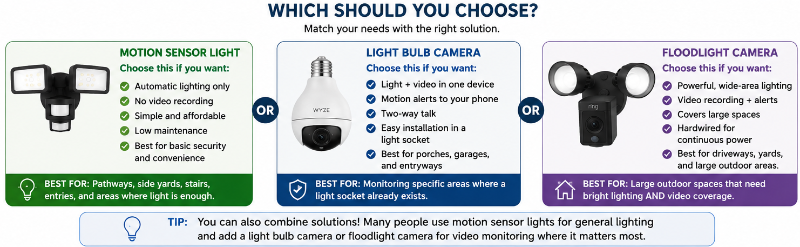
The best approach is to start with the location and ask what you actually need there:
Light only → motion sensor light
Light + easy camera installation → light bulb camera
Strong outdoor lighting + dedicated security camera → floodlight camera
For help choosing a camera, continue with our Light Bulb Camera Buying Guide.