Light bulb cameras can be an easy way to add security coverage to a home, apartment, garage or other property.
But because these cameras can record video, audio and activity around your property, an important question comes up:
Are light bulb cameras legal?
In general, owning and using a security camera is legal in many situations. However, where you install it, what it records, whether it captures audio, and the privacy expectations of the people being recorded can all matter.
A camera aimed at your own front entrance is very different from a camera aimed through a neighbour’s bedroom window.
Audio can also create additional legal concerns that do not necessarily apply to video alone.
This guide explains the major issues to consider in the United States and Canada, including neighbouring property, apartments, shared spaces, audio recording and areas where people have a greater expectation of privacy.
Important: This article provides general educational information, not legal advice. Surveillance and audio-recording laws can vary by country, state, province, municipality and situation. Check the laws that apply where the camera will actually be used.
Are Light Bulb Cameras Legal in the United States?
Generally, security cameras can legally be used to monitor your property in the United States, but that does not give you unlimited permission to record anything the camera can see or hear.
The circumstances matter.
Important considerations include:
- Where the camera is installed
- Where it is pointed
- Whether it records audio
- Whether people have a reasonable expectation of privacy
- Whether you own or rent the property
- Whether the camera monitors shared areas
- State and local laws
- Homeowners association or building rules
There is therefore no single rule that can answer every security-camera situation in every U.S. state.
Video and Audio Are Not the Same Legal Question
This is one of the most important things to understand about a light bulb camera.
A modern camera may contain:
- A video camera
- A microphone
- A speaker
- Motion detection
- Cloud or local recording
Just because the camera can legally capture video in a particular location does not automatically mean recording conversations in that location is permitted.
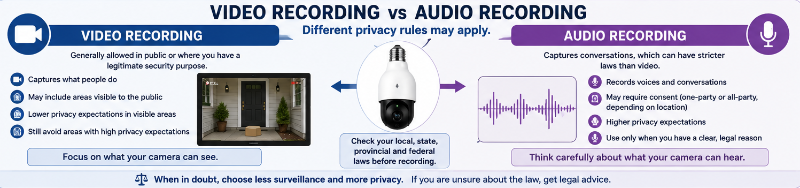
U.S. Federal Audio Law
Federal law generally prohibits intentionally intercepting protected wire, oral or electronic communications, subject to exceptions.
One important federal exception generally allows a person to record a communication when that person is a party to the communication or when one of the parties has given prior consent, provided the interception is not for a criminal or tortious purpose.
This is commonly described as a one-party consent rule at the federal level.
However, that does not mean you should assume a security camera can record every nearby conversation.
There are two important reasons.
First, a security camera owner may not actually be a participant in a conversation being captured by the camera’s microphone.
Second, individual states can have additional or stricter recording requirements.
For that reason, always check the law in the state where the camera is being used.
Are Light Bulb Cameras Legal in Canada?
Security cameras are also commonly used in Canada, but privacy and recording considerations still apply.
The fact that a camera is installed on your property does not automatically eliminate privacy concerns involving other people.
Canadian federal law also distinguishes private communications from ordinary visual surveillance.
Audio Recording in Canada
Canada’s Criminal Code generally prohibits knowingly intercepting a private communication using a device, subject to exceptions.
One important exception applies when the person intercepting the communication has the express or implied consent of either the originator of the private communication or the person intended to receive it.
This is often described as Canada’s one-party consent approach.
But there is an important distinction for security cameras:
If your camera records a private conversation between other people and you are not a participant in that conversation, you should not simply assume that the one-party consent exception protects the recording.
This is one reason homeowners should think carefully before leaving audio recording enabled unnecessarily.
Can You Point a Security Camera at Your Own Property?
Monitoring your own entrance, driveway, garage or yard is generally much less problematic than deliberately monitoring areas where other people expect privacy.
Good camera placement tries to capture the area you actually need for security.
For example, you might want to see:
- Your front door
- Your driveway
- Your garage entrance
- Your backyard gate
- A side entrance
The goal should be useful coverage, not maximum surveillance of everything around the property.
Can Your Camera See the Street or Sidewalk?
A front-door or driveway camera may inevitably capture part of a sidewalk, street or another publicly visible area.
That is different from deliberately positioning a camera to monitor someone’s private activities.
A useful principle is:
Capture what is reasonably necessary for your security purpose and minimize unnecessary coverage.
For example, if your goal is monitoring packages at your front door, you probably do not need the camera aimed primarily across the street.
Can You Point a Security Camera at Your Neighbour’s Property?
This requires more care.
Some incidental neighbouring property may appear at the edge of a camera’s field of view simply because of where homes are located.
That is different from intentionally positioning the camera to monitor a neighbour.
Avoid aiming cameras:
- Through a neighbour’s windows
- Into private backyard areas unnecessarily
- At bedroom windows
- At bathroom windows
- Into areas specifically chosen to observe private activity
If the camera provides privacy zones or masking, consider using them to block areas that you do not need to monitor.
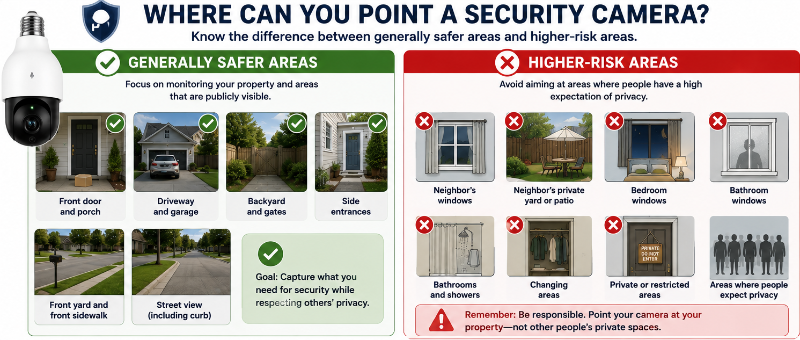
What Is a Reasonable Expectation of Privacy?
The concept of a reasonable expectation of privacy is important when thinking about surveillance.
People generally expect much more privacy in some locations than others.
For example, compare:
Front sidewalk: relatively visible to other people.
Bathroom: extremely high expectation of privacy.
Those are very different surveillance situations.
Locations that deserve particular caution include:
- Bathrooms
- Bedrooms used by guests or tenants
- Changing areas
- Showers
- Locker rooms
- Other locations where people may undress
Canada’s Criminal Code, for example, contains voyeurism provisions involving surreptitious observation or visual recording in circumstances that give rise to a reasonable expectation of privacy.
Where Should You NOT Install a Light Bulb Camera?
Avoid thinking only about whether there happens to be a convenient light socket.
A socket may provide power while still being a terrible location for a security camera.
High-risk or inappropriate placements can include cameras:
- Aimed into bathrooms
- Aimed into changing areas
- Aimed unnecessarily through neighbouring windows
- Placed where guests reasonably expect significant privacy
- Positioned primarily to monitor another person’s private activities
For a complete placement guide, see Where NOT to Install a Light Bulb Camera.
What About Cameras Inside Your Own Home?
Owning a home does not mean every possible recording inside it is automatically appropriate or lawful.
Think about who uses the area and what they reasonably expect.
An indoor camera monitoring an exterior entrance is different from secretly recording a guest in a private sleeping or changing area.
If household members, guests, caregivers, cleaners, contractors or other people regularly enter the home, consider whether they should know that cameras are operating.
Audio deserves additional consideration because the microphone may capture conversations well beyond the camera’s visible field of view.
Are Hidden Cameras Legal?
Hidden or concealed surveillance can raise substantially greater privacy concerns than an obvious security camera.
Do not assume that owning the property automatically makes covert recording lawful.
The location, purpose, people being recorded, expectation of privacy and applicable laws can all matter.
A light bulb camera should not be used as a way to secretly record people in highly private situations.
Are Light Bulb Cameras Legal in Apartments?
Apartment installations can be more complicated because you may not control all of the property around your door.
A camera installed near an apartment entrance might capture:
- A shared hallway
- A neighbour’s door
- Other tenants
- Visitors
- Building employees
- Shared stairs or elevators
You may also have:
- Lease restrictions
- Building policies
- Condo or homeowners association rules
- Restrictions on modifying fixtures
Before installing a camera in a shared area, check the rules that apply to your building.
For more, see Best Light Bulb Cameras for Apartments.
What About Landlords and Rental Properties?
Landlords face additional privacy considerations when using surveillance around rental properties.
A camera monitoring a building entrance or parking area is very different from one capturing the inside of a tenant’s home.
In Canada, federal privacy guidance for landlords says surveillance cameras should not capture the inside of apartments and recommends that tenants be informed about surveillance policies where applicable.
U.S. requirements can vary by state and local law.
Landlords should not assume that property ownership creates unlimited surveillance rights over tenants.
What About Condos and HOAs?
Even when a camera would otherwise be legally permissible, building or association rules may restrict where devices can be installed.
Rules may cover:
- Exterior modifications
- Common areas
- Shared electrical fixtures
- Hallways
- Doorways
- Camera placement
Check the applicable condo, strata, homeowners association or building rules before installing a camera in a shared or controlled area.
Can You Record Delivery Drivers and Visitors?
A security camera at a front entrance will naturally capture people approaching the property.
That can include:
- Delivery drivers
- Visitors
- Contractors
- Postal workers
- People approaching the door
The more complicated issue may be audio.
A microphone might capture conversations that extend beyond the security purpose of watching the entrance.
If you do not need recorded audio, consider disabling it.
See Do Light Bulb Cameras Record Audio? for a more detailed explanation.
Do You Need a Security Camera Sign?
There is no universal rule requiring every homeowner in the United States or Canada to put up a sign simply because an exterior security camera is present.
However, requirements can vary depending on:
- Jurisdiction
- Whether the property is residential or commercial
- Whether audio is being recorded
- Whether tenants, employees or customers are being monitored
- Applicable privacy laws
Even when a sign is not legally required, visible notice can sometimes improve transparency.
Do not treat a sign as permission to record anything you want. A notice does not automatically override privacy or audio-recording laws.
Does a Camera Have to Be Visible?
Not necessarily in every situation, but visible cameras generally create fewer surprises than hidden surveillance.
An obvious camera can also serve the practical purpose of letting visitors know that the area is monitored.
If you are considering covert surveillance, particularly indoors, seek location-specific legal guidance before proceeding.
What About Cameras at a Business or Workplace?
Business and workplace surveillance can involve rules that do not apply in exactly the same way to a homeowner monitoring a private residence.
Issues can include:
- Employee privacy
- Customer privacy
- Notice requirements
- Data retention
- Access to recordings
- Audio recording
- Applicable state, provincial or federal privacy laws
Canadian privacy guidance for private-sector organizations recommends limiting surveillance to what is necessary, positioning cameras to reduce unnecessary collection, avoiding areas with heightened privacy expectations, and not recording sound unless there is a specific need.
Businesses should obtain advice applicable to their jurisdiction and circumstances rather than relying on residential-camera guidance.
Does Pan-and-Tilt Create Additional Privacy Concerns?
It can.
A fixed camera has a relatively predictable viewing area.
A motorized pan-and-tilt camera can potentially be moved to capture areas outside its normal position.
When setting one up, test its full movement range.
Ask:
- Can it rotate toward a neighbour’s window?
- Can it see into an area you do not need to monitor?
- Does automatic tracking move the camera beyond the intended area?
- Can privacy zones be configured?
Do not judge privacy only by where the lens points when the camera is sitting idle.
Does 24/7 Recording Change Anything?
Continuous recording can collect much more information than short motion-triggered events.
That does not automatically make continuous recording unlawful, but it increases the importance of considering:
- What the camera captures
- How long footage is stored
- Who can access recordings
- Whether audio is included
- Whether continuous collection is actually necessary
A privacy-conscious setup collects what is reasonably needed for the security purpose rather than simply recording as much as technically possible.
What About Facial Recognition and AI Detection?
Some security cameras provide advanced detection features that can distinguish people, vehicles, packages or other events.
More advanced systems may offer facial recognition or person identification.
These features can introduce additional privacy considerations because the system may be doing more than simply recording a scene.
If a camera offers these features, review:
- What information is analyzed
- Whether data leaves the camera
- Whether information is stored in the cloud
- How long information is retained
- Whether the feature can be disabled
- The manufacturer’s privacy policy
Privacy Zones Can Be Useful
Some cameras allow you to create privacy masks or privacy zones.
These can block portions of the image that you do not want the camera monitoring.
For example, you might mask:
- A neighbour’s window
- An adjacent patio
- A portion of a neighbouring yard
- Another area unrelated to your security purpose
Availability and behaviour vary by camera, so verify how the feature works before relying on it.
Light Bulb Camera Legal & Privacy Checklist
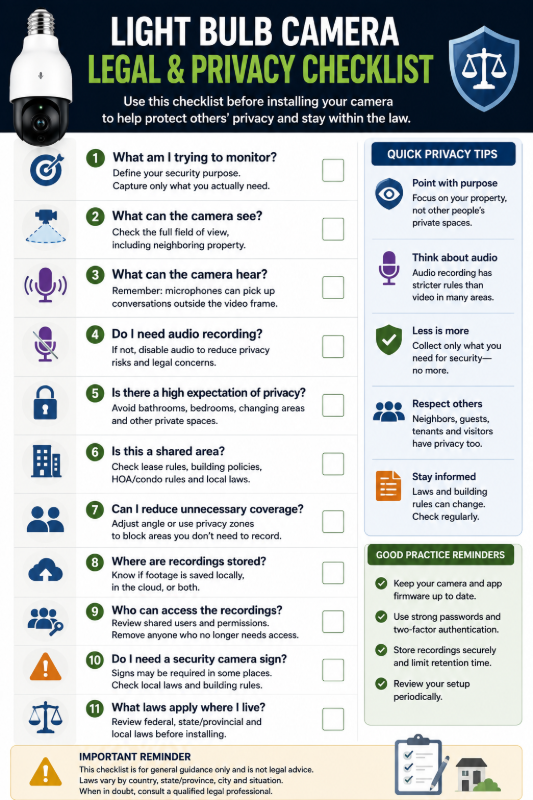
Before installing your camera, work through these questions.
1. What Am I Trying to Monitor?
Define the actual security purpose.
For example:
“I want to monitor packages and visitors at my front door.”
That makes it easier to determine how much coverage you actually need.
2. What Can the Camera See?
Check the complete field of view, including neighbouring property.
3. What Can the Camera Hear?
A microphone may capture conversations outside the video frame.
4. Do I Need Audio?
If not, consider disabling audio recording.
5. Does Anyone Have a High Expectation of Privacy Here?
Pay particular attention to bathrooms, bedrooms, changing areas and other private locations.
6. Is This a Shared Area?
Apartment hallways, condos and shared entrances can require additional consideration.
7. Are There Building or HOA Rules?
Check before modifying shared fixtures or installing equipment.
8. Can I Reduce Unnecessary Coverage?
Adjust the camera angle or use privacy zones where available.
9. Where Are Recordings Stored?
Know whether footage is stored locally, in the cloud or both.
10. Who Can Access the Recordings?
Review shared accounts and permissions.
11. What Laws Apply Where I Live?
Check country, state, provincial and local requirements when necessary.
A Simple Placement Rule
A useful general principle is:
Point the camera at the area you need to protect, not at people or property you have no reason to monitor.
For example:
Better: Your camera primarily captures your front door, porch and packages.
Higher concern: Your camera is deliberately aimed through the neighbour’s window across the street.
Good placement improves both privacy and camera usefulness.
Frequently Asked Questions
Are light bulb cameras legal?
They can be legal to own and use, but legality depends on where the camera is installed, what it captures, whether it records audio and the laws that apply in your location.
Can I put a light bulb camera outside my house?
Potentially, yes, if the camera and installation are suitable for outdoor use. You should also position it to monitor the intended area while minimizing unnecessary intrusion into private areas.
Can my security camera point at my neighbour’s house?
Incidental neighbouring property may appear in a camera’s field of view, but deliberately monitoring areas where neighbours have a strong expectation of privacy can create serious concerns. Aim and limit the camera to what you reasonably need to monitor.
Can a security camera record the sidewalk?
A front-door or driveway camera may incidentally capture a sidewalk or street. Laws vary, and audio or targeted surveillance can raise additional issues.
Can I record audio with my light bulb camera?
Possibly, but audio recording laws can be different and more restrictive than ordinary video surveillance rules. Check the laws that apply where the camera is being used.
Do I need permission from my neighbour?
There is no universal rule covering every camera installation. The answer depends on the jurisdiction, camera placement, what is being recorded and the circumstances. Minimizing unnecessary capture of neighbouring property is a good practice regardless.
Do I need a sign saying I have security cameras?
Not every residential installation in the United States or Canada requires signage, but requirements can vary. Businesses, landlords, workplaces and audio recording can involve different obligations.
Can I install a light bulb camera in an apartment hallway?
Possibly, but shared hallways introduce lease, building and privacy considerations. Check your lease and building policies before installation.
Can I install a security camera in a bathroom if it is my house?
Bathrooms are areas where people generally have a very high expectation of privacy. Do not use a security camera to secretly observe or record people in bathrooms or similar highly private areas.
Does turning off audio make a camera legal?
Not automatically. Disabling audio can remove one important concern, but video placement and privacy issues can still remain.
Final Thoughts
Light bulb cameras themselves are not inherently illegal.
The bigger questions are:
- Where is the camera installed?
- Where is it pointed?
- What does it record?
- Does it capture audio?
- Who is being recorded?
- Do those people have a reasonable expectation of privacy?
- What laws and building rules apply?
For most homeowners, a good starting principle is simple:
Use the camera to monitor your property while collecting as little unnecessary information about other people as reasonably possible.
Keep the camera focused on the area you actually need to protect, avoid highly private locations, think carefully about audio recording, and use privacy zones when they can reduce unnecessary coverage.
If you are dealing with a complicated situation involving neighbours, tenants, employees, hidden cameras or private conversations, get advice specific to your jurisdiction rather than relying on general internet guidance.
Related Guides
- Do Light Bulb Cameras Record Audio?
- Where NOT to Install a Light Bulb Camera
- Privacy-First Light Bulb Camera Buyer Checklist
- Are Light Bulb Cameras Safe From Hacking?
- Where to Install a Light Bulb Camera
- Light Bulb Camera Buyer Checklist
Legal Disclaimer: This article is for general educational purposes only and is not legal advice. Security-camera, privacy and audio-recording laws vary by jurisdiction and circumstances. Check applicable federal, state, provincial and local laws or consult a qualified legal professional if you are uncertain about your installation.